
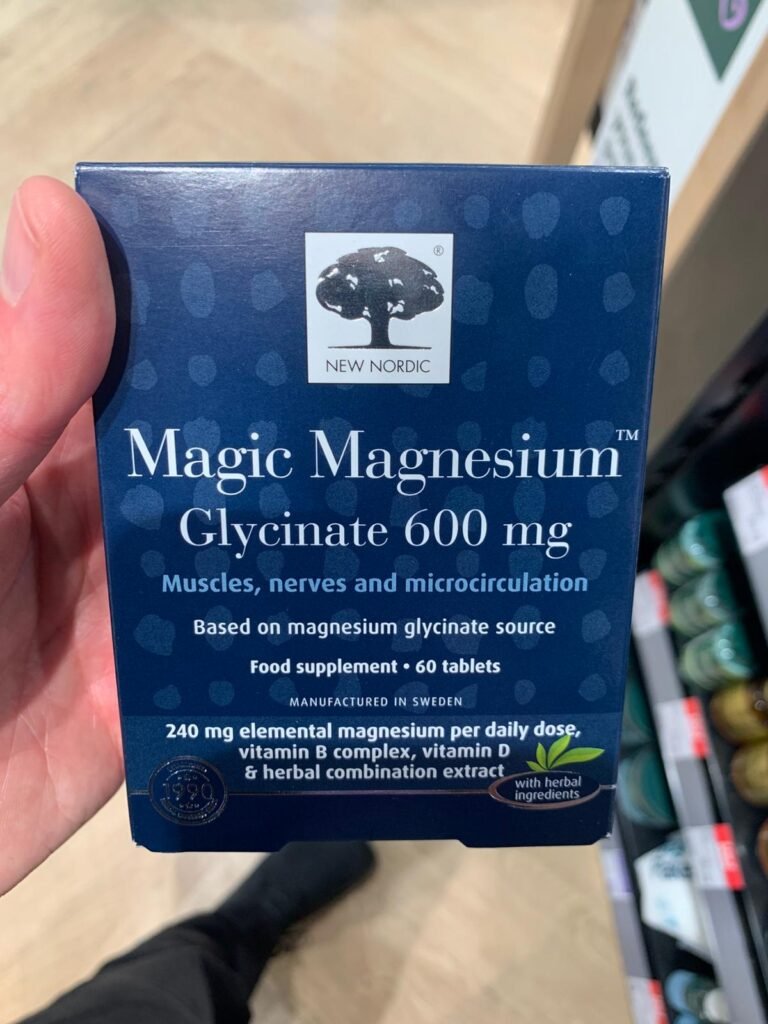
Magnesium glycinate has become one of the most talked-about supplements online. In consumer-facing supplement content, especially in pharmacy and wellness retail, it is often positioned as the “best magnesium” for sleep, stress, relaxation, and gentle digestion. In Ireland, that public-facing language shows up again and again in retail and pharmacy content around “magnesium for sleep,” “magnesium for anxiety,” “calm,” and “gentle on the stomach.”
That popularity has created a problem: a lot of people now expect magnesium glycinate to work like a magic pill. It does not. Magnesium glycinate can be a useful supplement in the right context, but its real benefits are more modest, more specific, and more dependent on the person taking it than social media often suggests.
What is magnesium glycinate?
Magnesium glycinate, also called magnesium bisglycinate, is a form of magnesium bound to the amino acid glycine. Official ingredient databases list magnesium glycinate and magnesium bisglycinate as accepted names for this compound.
The important thing to understand is that the main physiological effects come from magnesium itself. Magnesium is a cofactor in more than 300 enzyme systems and is involved in protein synthesis, muscle and nerve function, blood glucose control, blood pressure regulation, energy production, bone development, DNA and RNA synthesis, and normal heart rhythm.
So when people ask, “What does magnesium glycinate do?” the honest answer is this: it is one way of supplementing magnesium, not a different mineral with completely different powers.
Why is magnesium glycinate so popular?
A big reason is marketing. Consumer supplement pages frequently describe magnesium glycinate as highly absorbable, calming, sleep-friendly, good for stress, and easier on the stomach than some other forms. That language is especially common in Irish pharmacy and wellness retail content.
Some of that popularity also comes from a real advantage: magnesium glycinate is commonly marketed as a well-tolerated option for people who want to supplement magnesium without the more noticeable laxative effect associated with some other forms. Official guidance from the NIH notes that magnesium supplements can vary in absorption and that some forms are more likely than others to cause diarrhea.
Myth 1: Magnesium glycinate will fix your sleep
This is probably the biggest myth.
Magnesium is heavily marketed for sleep, and magnesium glycinate is often presented as the “best magnesium for sleep.” But the strongest official sources are much more cautious. The U.S. National Center for Complementary and Integrative Health says there is very little research on magnesium for insomnia, and that the available studies are small, mixed, and not strong enough to support confident conclusions.
That does not mean it is useless. It means the evidence is limited. Some studies suggest magnesium may help certain sleep measures in some people, especially older adults with insomnia or people with lower magnesium status, but it is not something you should expect to work like a sedative or a guaranteed sleep solution.
Myth 2: Magnesium glycinate will eliminate stress and anxiety
This is another area where public expectation is bigger than the evidence.
A recent systematic review found that supplemental magnesium is popular for anxiety and insomnia and that many of the included studies showed improvement in at least one sleep- or anxiety-related outcome. But the authors also emphasized that the data are heterogeneous, most studies are small, and larger trials are still needed. Their conclusion was that magnesium is likely useful for mild anxiety and insomnia, particularly in people with low magnesium status at baseline, not that it is a proven treatment for anxiety disorders.
So magnesium glycinate may support relaxation for some people, but it should not be sold as a substitute for treating chronic anxiety, high stress load, or poor sleep habits.
Myth 3: Magnesium glycinate dramatically lowers blood pressure
Magnesium does play a role in blood pressure regulation, and magnesium supplementation has shown small blood pressure effects in clinical research. But “small” is the key word.
The NIH notes that magnesium supplementation only marginally lowers blood pressure. Meta-analyses cited by the NIH found reductions of only a few mmHg, not dramatic changes.
So if someone takes magnesium glycinate expecting it to act like a blood pressure treatment on its own, that expectation is unrealistic.
Myth 4: Magnesium glycinate is proven to be the best magnesium for everyone
This is another oversimplification.
The NIH explains that magnesium absorption differs across supplement forms and highlights evidence for good absorption with forms such as aspartate, citrate, lactate, and chloride compared with oxide and sulfate. In other words, there is no official basis for claiming that glycinate is universally the best option for every goal and every person.
Magnesium glycinate may be a sensible option when someone wants a supplement that is commonly marketed as gentle on digestion and suitable for ongoing use, but “best” depends on the goal, the dose, the person, and tolerability.
Myth 5: If some magnesium is good, more must be better
Not true.
High intakes of magnesium from supplements or medications can cause diarrhea, nausea, and abdominal cramping. Very high doses can lead to magnesium toxicity, including low blood pressure, vomiting, difficulty breathing, irregular heartbeat, cardiac arrest, and, in rare cases, death. The NIH sets the tolerable upper intake level for supplemental magnesium at 350 mg per day for adults unless supervised by a healthcare professional.
This is one of the biggest reasons not to treat magnesium glycinate like a harmless “more is better” supplement.
What are the real benefits of magnesium glycinate?
Now for the part that matters most: what magnesium glycinate may actually help with.
1. Supporting normal magnesium-dependent functions in the body
This is the most evidence-based benefit.
Magnesium supports muscle and nerve function, energy production, blood glucose control, blood pressure regulation, bone health, and normal heart rhythm. If someone’s intake is low, or if their magnesium status is affected by diet, medications, or physiology, supplementing magnesium may help support those normal functions.
2. Helping correct low magnesium intake or depletion
Not everyone who takes magnesium is deficient, but some people are at higher risk of low magnesium intake or low magnesium status. The NIH notes that magnesium deficiency can present with symptoms such as loss of appetite, nausea, fatigue, weakness, cramps, and in more severe cases neurological or cardiac symptoms.
This is where magnesium supplements often make the most sense: not as a universal shortcut, but as a tool when magnesium status is likely part of the problem.
3. Migraine prevention in some people
This is one of the more interesting evidence-based use cases.
The NIH says low serum and tissue magnesium appear to be associated with migraine headaches, and some research suggests regular magnesium supplementation may reduce migraine frequency. The American Academy of Neurology and the American Headache Society have concluded that magnesium is probably effective for migraine prevention.
That does not mean everyone with headaches should start magnesium glycinate on their own, but it is one of the more credible clinical applications of magnesium supplementation.
4. Possibly helping mild sleep or anxiety symptoms in selected people
This is where the nuance matters.
Magnesium may be useful for mild insomnia or anxiety symptoms, especially in people with lower magnesium status, but the evidence is still not strong enough to support aggressive promises. The most honest summary is that it may help some people, but it is not a guaranteed fix.
5. Providing a more tolerable option for people who do not do well with other forms
Magnesium glycinate is commonly marketed as gentler on digestion than some other magnesium forms, and that is one of the main reasons people choose it. While official sources do not single glycinate out as uniquely superior across all outcomes, the broader evidence does show that magnesium supplements differ in absorption and gastrointestinal tolerance.
What should you realistically expect from magnesium glycinate?
The most realistic expectation is subtle support, not a dramatic overnight transformation.
If magnesium glycinate helps you, it is more likely to feel like:
- better overall magnesium support
- slightly improved relaxation or evening wind-down
- fewer problems related to low magnesium intake
- a supplement you tolerate better than harsher forms
- possible support for migraines or mild sleep issues in the right context
What you should not expect is:
- an instant fix for insomnia
- a cure for stress or anxiety
- major blood pressure changes
- a replacement for diet, routine, hydration, recovery, or medical care
- a “magic pill” that solves fatigue on its own
Who should be more careful?
Magnesium supplements can interact with medications. The NIH notes interactions with oral bisphosphonates, tetracycline and quinolone antibiotics, while diuretics and proton pump inhibitors can affect magnesium status.
That means magnesium glycinate is not something to take casually if you are on prescription medication, have kidney issues, or are already taking multiple supplements.
Final takeaway
Magnesium glycinate is not nonsense, but it is not magic either.
It is a form of magnesium, often chosen because it is commonly marketed as well tolerated and associated with calm, sleep, and relaxation. The real science supports magnesium as an essential mineral involved in hundreds of functions in the body, and it supports specific use cases such as correcting low magnesium intake, supporting normal muscle and nerve function, and possibly helping with migraine prevention. Sleep and anxiety support are promising areas, but the evidence is still limited and not strong enough to justify miracle-style claims.
So if you are thinking about magnesium glycinate, the smartest mindset is this: use it as a tool, not as a fantasy. In the right person, with the right expectations, it may be useful. But it works best as part of a wider strategy that includes food quality, sleep habits, stress management, and an honest look at what is really driving the symptom you want to improve.