Pumpkin seed oil is one of those supplements that gets pulled into several different conversations at once. Some people take it for prostate or urinary symptoms. Others buy it for hair growth. In the Irish market, it is also tied to broader expectations around men’s health and even testosterone. That popularity makes it important to separate what pumpkin seed oil is actually supported for from what people merely hope it will do.
What is pumpkin seed oil?
Pumpkin seed oil is oil extracted from pumpkin seeds, usually from Cucurbita pepo or related pumpkin species. Reviews and composition studies describe it as rich in unsaturated fatty acids, especially linoleic and oleic acid, along with tocopherols and phytosterols. Cold-pressed pumpkin seed oil is also described as containing sterols, carotenoids, and other bioactive compounds that help explain why it is discussed as a functional food as well as a supplement.
That composition matters because most of the interest around pumpkin seed oil comes from those compounds, not from the oil being “magical” on its own. The Irish Health Products Regulatory Authority notes that, in medicinal pumpkin species, the fatty oil contains specific delta-7 sterols, which are suggested to contribute to activity. The same HPRA document also notes that the active constituents have not been finally substantiated, which is an important reminder that plausible biology is not the same thing as a fully proven clinical outcome.
How is pumpkin seed oil thought to work?
The most realistic answer is that pumpkin seed oil has proposed mechanisms, not one fully proven single mechanism. According to the HPRA, pumpkin seed and pumpkin seed oil have shown urodynamic and antiphlogistic effects, which means effects relevant to bladder function and inflammation. Experimental literature also suggests a role for pumpkin-derived sterols in pathways related to 5-alpha-reductase, an enzyme involved in androgen metabolism.
That matters because two of the biggest reasons people buy pumpkin seed oil, prostate support and hair loss support, both often get linked to androgen-related pathways. One PubMed-listed hair study notes that pumpkin seed oil had previously been shown to block the action of 5-alpha-reductase and to have antiandrogenic effects in rats, which is one reason researchers became interested in it for androgenetic alopecia.
Why do people in Ireland search for pumpkin seed oil?
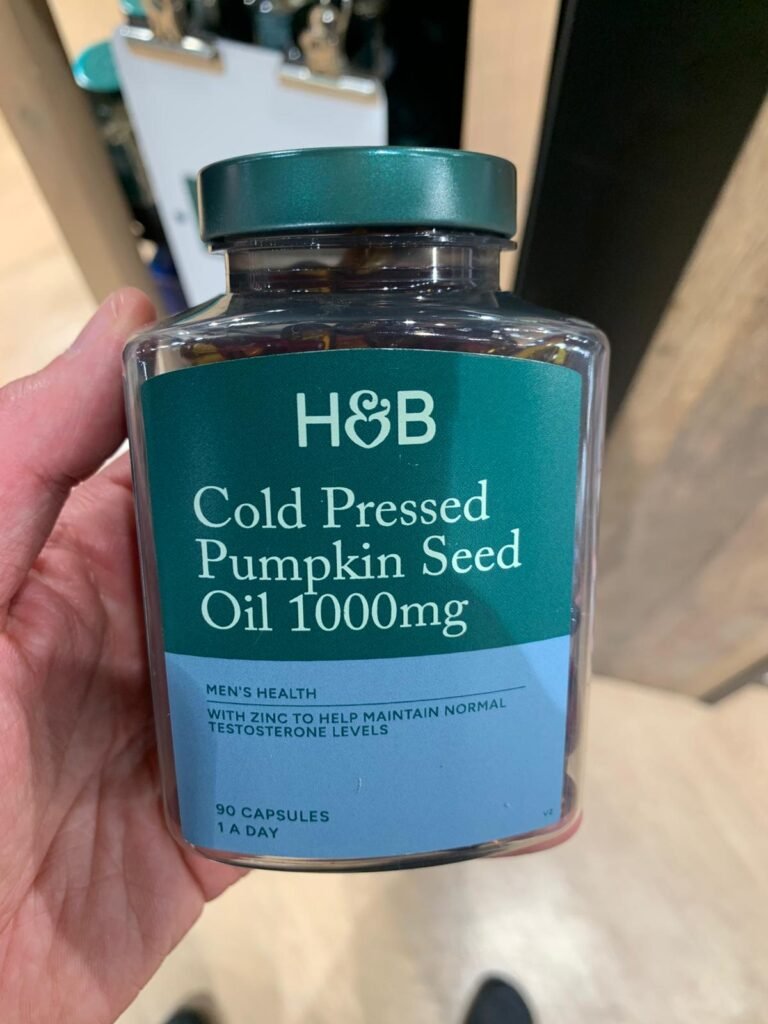
In Ireland, the supplement is mostly associated with prostate health, urinary support, hair growth, and sometimes men’s hormones/testosterone. That pattern shows up clearly in Irish retail and professional pharmacy content. H&B Ireland sells pumpkin seed oil capsules with added zinc and explicitly frames the product around a “testosterone boost.” Its prostate-health content also says pumpkin oil is considered good for prostates because it is rich in zinc, carotenoids, and phytosterols.
Irish professional pharmacy content also shows a strong association with hair loss. Irish Pharmacist described pumpkin seed oil as one of the plant-based options studied for alopecia and cited a 24-week double-blind RCT in men showing a notable increase in hair count versus placebo. At the same time, the HPRA’s licensed traditional herbal medicine information places pumpkin seed and pumpkin seed oil firmly in the bladder-prostate space, specifically for relief of lower urinary tract symptoms in men, though in that licensed product they are combined with saw palmetto.
So, in plain language, the Irish public seems to associate pumpkin seed oil with these hopes:
- “It will help my prostate.”
- “It will help me pee less often.”
- “It might help my hair grow back.”
- “It may support men’s hormones or testosterone.”
Myth 1: Pumpkin seed oil is a proven cure for prostate enlargement
This goes too far.
There is meaningful evidence that pumpkin seed products may help with symptoms of benign prostatic hyperplasia, especially lower urinary tract symptoms such as urgency, frequency, and quality-of-life burden. A one-year randomized placebo-controlled study in men with BPH found a clinically relevant reduction in IPSS, the standard symptom score used for prostate-related urinary symptoms. Another randomized trial found that both pumpkin seed oil and tamsulosin improved BPH symptoms, although pumpkin seed oil was not as effective as tamsulosin.
So the real position is not “pumpkin seed oil cures BPH.” The real position is that it may provide symptom relief for some men with BPH-related urinary symptoms, but it should not be treated as equivalent to prescription therapy. That is also why the HPRA says serious underlying conditions should be ruled out by a doctor before using a traditional herbal medicine for urinary symptoms.
Myth 2: Pumpkin seed oil will definitely regrow your hair
This is one of the most popular claims, and it is easy to see why.
There really was a randomized, double-blind, placebo-controlled trial in men with androgenetic alopecia. That study is one of the reasons pumpkin seed oil became widely discussed in hair-loss circles. Irish Pharmacist summarizes that 24-week RCT as showing about a 40% increase in hair count in the pumpkin seed oil group versus 16% in placebo. That is a promising signal.
But promising is not the same thing as guaranteed. The evidence base for pumpkin seed oil and hair loss is still much smaller than the evidence for mainstream treatments such as minoxidil or finasteride. The best way to describe the current position is that pumpkin seed oil is an interesting adjunct or alternative worth further study, not a proven universal solution for hair regrowth.
Myth 3: Pumpkin seed oil is basically a testosterone supplement
This is a good example of how the market can shape expectations.
Some Irish product pages connect pumpkin seed oil to “testosterone boost,” but in the example from H&B Ireland, that specific product contains added zinc, and the testosterone framing is tied to the formula, not solid proof that pumpkin seed oil alone raises testosterone in a clinically meaningful way. The stronger research themes around pumpkin seed oil are still urinary symptoms and, to a lesser extent, hair.
So, if people in Ireland are buying pumpkin seed oil thinking it will work like a dedicated hormone supplement, that expectation is stronger than the evidence currently supports. The more honest view is that pumpkin seed oil may interact with androgen-related pathways, but that is not the same thing as proving it is a testosterone booster.
Myth 4: Pumpkin seed oil is proven for everything from heart health to skin to hair to bladder
This is where nutrient profile and supplement claims get mixed together.
Pumpkin seed oil is rich in unsaturated fats, tocopherols, and phytosterols, so it makes sense that it is often sold with broad wellness language. But a nutritious composition does not automatically translate into strong clinical evidence for every claim that appears on a supplement label. The strongest human supplement evidence is still concentrated around BPH/lower urinary tract symptoms, overactive bladder, and some hair-loss data, not around every broad wellness benefit people sometimes attach to it.
Myth 5: Because it is a natural oil, it must be harmless
This is another oversimplification.
Pumpkin seed oil has looked generally well tolerated in the urinary-symptom trials, and the tamsulosin comparison trial reported symptom relief with no side effects in that study group. But “well tolerated in a study” does not mean “risk free for everyone.” The HPRA’s licensed traditional herbal product warns that urinary symptoms can reflect serious underlying conditions, and advises medical review if symptoms persist, worsen, or are accompanied by red flags such as blood in the urine, urinary retention, pain, or fever.
So the correct mindset is not fear, but caution. A supplement should never delay proper assessment of persistent bladder or prostate symptoms.
What are the real benefits of pumpkin seed oil?
The best-supported real-world benefit is support for urinary symptoms, especially in men with BPH-related lower urinary tract symptoms. That is where the human research is most established. One-year randomized data found clinically relevant improvement in symptom scores versus placebo, and another randomized trial found meaningful improvement, although less than with tamsulosin.
A second plausible benefit is support for overactive bladder symptoms. A human study cited in PubMed found that pumpkin seed oil extracts from Cucurbita maxima and Cucurbita pepo were effective for urinary disorders such as overactive bladder in humans. A more recent review of medicinal plants for overactive bladder also points to symptom improvements in urgency and related measures with pumpkin seed oil in small studies.
A third possible benefit is hair support in androgenetic alopecia, particularly in men. The evidence is not large, but the RCT signal is real enough to make this more than just a random internet claim. It is fair to call it promising, but not fair to call it established.
What should you realistically expect?
If pumpkin seed oil helps you, the effect is likely to be specific and gradual, not dramatic and universal.
For urinary symptoms, realistic expectations would be:
- some improvement in urgency, frequency, or symptom burden
- changes that take weeks to months, not days
- benefits that may still be smaller than prescription treatment in some cases
For hair, realistic expectations would be:
- possible improvement over months
- not guaranteed regrowth
- not a substitute for evidence-based medical options if the hair loss is significant or progressive
And for the broader wellness expectations common in the Irish market, such as testosterone, major hormone support, or broad “men’s vitality,” the evidence is simply not strong enough to promise those outcomes confidently.
Frequently Asked Questions
What is pumpkin seed oil?
Pumpkin seed oil is oil extracted from pumpkin seeds, usually from Cucurbita pepo or related species. It is rich in unsaturated fatty acids, tocopherols, and phytosterols.
What is pumpkin seed oil mainly used for?
The strongest supplement-related use is support for lower urinary tract symptoms, especially those linked to benign prostatic hyperplasia. It is also studied for overactive bladder and hair loss.
Can pumpkin seed oil help with prostate symptoms?
It may help relieve lower urinary tract symptoms in some men with BPH, but it is not as well established as prescription treatment and should not replace medical assessment.
Can pumpkin seed oil help with overactive bladder?
Some small human studies suggest it may improve overactive bladder symptoms, so this is a plausible use, but the evidence is still limited.
Does pumpkin seed oil regrow hair?
There is one well-known randomized placebo-controlled trial in men with androgenetic alopecia showing improvement in hair count, so the claim is not baseless. But the evidence is still limited and not strong enough to promise regrowth for everyone.
Is pumpkin seed oil a testosterone booster?
The Irish market sometimes frames it that way, especially in formulas that also contain zinc, but the stronger evidence for pumpkin seed oil itself is in urinary symptoms and hair, not testosterone.
How does pumpkin seed oil work?
Its effects are thought to relate to its fatty acids and phytosterols, including delta-7 sterols. Proposed mechanisms include anti-inflammatory effects, urodynamic effects, and possible influence on 5-alpha-reductase-related pathways.
Is pumpkin seed oil safe?
It appears generally well tolerated in clinical studies, but persistent urinary symptoms still need proper medical evaluation because they may reflect more serious conditions.
How long does pumpkin seed oil take to work?
The studies suggesting benefit for urinary symptoms or hair growth looked at changes over weeks to months, not overnight results.
What should I realistically expect from pumpkin seed oil?
Think in terms of possible symptom support, not dramatic transformation. The most realistic expectations are modest help with urinary symptoms and possibly some hair support in the right context.
Final takeaway
Pumpkin seed oil is not nonsense, but it is also not a miracle supplement. It is a bioactive oil rich in unsaturated fatty acids, tocopherols, and phytosterols, including delta-7 sterols that may be relevant to its physiological activity. The most credible benefits are for lower urinary tract symptoms/BPH, possible overactive bladder support, and promising but still limited hair-loss support.
In Ireland, people often approach pumpkin seed oil with hopes around prostate health, hair growth, and sometimes testosterone. The first two have at least some real basis in the literature. The third is more marketing-driven than evidence-driven. The smartest position is to see pumpkin seed oil as a potential support tool, not as a cure-all.